

Every week, our sales team in Hangzhou fields RFQs from distributors who describe what they want in vague terms — “good quality PVC ceiling, cheap price.” The problem is that vague specs lead to wrong shipments, failed inspections, and costly returns REACH or RoHS documentation 1. Without a precise specification, buyers gamble with their margins and reputation.
Procurement professionals define PVC ceiling requirements by specifying panel dimensions, material thickness, density, fire rating, moisture resistance, surface finish, edge profile, VOC compliance, and installation compatibility — then qualifying suppliers through certifications, test reports, sample testing, and documented quality control benchmarks before placing bulk orders.
This article walks through the exact specification process that experienced buyers use dimensional tolerances 2. Each section below tackles a real procurement decision — from PVC content and thickness to fire certifications, shipping optimization, and quality control benchmarks. Whether you source five containers at a time or you are building your first specification sheet, these details will save you money and headaches.
How do I choose the right PVC content and thickness to meet my local market standards?
A lesson we learned early at our Zhejiang production base: two panels can look identical on the outside yet perform completely differently on site. The difference almost always comes down to PVC resin content 3 and actual wall thickness — two factors that buyers in Latin America and Southeast Asia now ask us to document before every shipment.
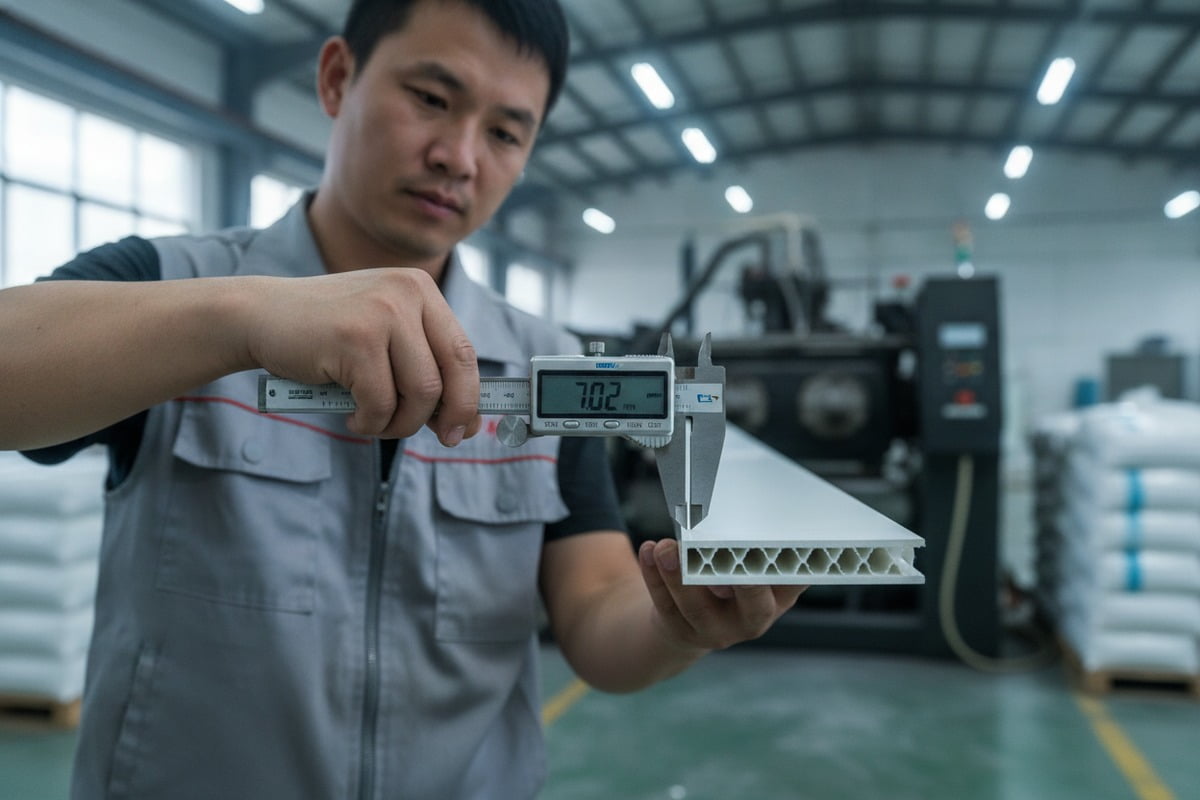
Choose PVC content and thickness by matching your local climate, building code, and end-use application. Virgin PVC resin at 45–55% content with calcium carbonate filler delivers the best balance of rigidity and cost, while a thickness of 7–8 mm suits most commercial and residential ceiling projects in humid markets.
Why PVC Content Matters More Than You Think
PVC resin content directly controls a panel's rigidity, UV stability, and long-term durability. Panels made with a higher percentage of virgin PVC resin 4 resist yellowing, sagging, and cracking far better than those padded with excess calcium carbonate filler. When our quality control team tests incoming resin batches, we look for consistent K-value 5 (a measure of molecular weight) because it predicts how the panel will behave years after installation.
Recycled PVC can reduce raw material cost by 10–15%, but it introduces variability. Color consistency drops. Chemical resistance weakens. For buyers who do private-label resale in markets like Ecuador or Colombia, that inconsistency shows up as customer complaints and returns. That is why most serious procurement professionals specify virgin PVC resin in their purchase orders.
Thickness: The Number Everyone Asks About First
Thickness is the easiest spec to measure, so it becomes the default quality proxy. But thickness alone does not tell the whole story. A 7 mm panel with low-density filler will flex and sag over a 250 mm span, while a well-formulated 6 mm panel with proper density holds firm. Still, market expectations matter. Here is how thickness requirements break down by region and use case based on the orders we process most frequently:
| Application | Recommended Thickness | Typical Width | Common Markets |
|---|---|---|---|
| Residential bathroom / kitchen ceiling | 7–8 mm | 250 mm | Latin America, Southeast Asia |
| Commercial office / retail ceiling | 8–10 mm | 250–300 mm | Middle East, India |
| Hotel corridor / hospitality | 8–9 mm | 200–250 mm | Latin America, Southeast Asia |
| Industrial back-of-house | 5–7 mm | 300 mm | All regions |
| Premium decorative ceiling (marble/wood finish) | 8–12 mm | 250 mm | Middle East, Latin America |
Density vs. Thickness — A Critical Distinction
Our production engineers measure density in kg/m³ after every extrusion run. A well-made PVC ceiling panel typically falls between 1.3 and 1.5 kg/m³ of apparent density 6 depending on the profile. Panels that feel unusually light for their thickness usually contain too much filler and too little resin. The quick field test many of our distributors use: hold a panel by one end horizontally. If it droops noticeably within seconds, the density is too low regardless of what the thickness gauge reads.
When writing your specification, state both minimum thickness and minimum linear weight (grams per linear meter). This dual requirement closes the loophole where a supplier inflates thickness by adding air gaps or low-density core layers. For a standard 250 mm × 7 mm panel, we typically see a target linear weight of around 750–950 g/m, depending on the profile and finish.
What fire-retardant certifications and test reports must I verify before placing a bulk order?
One of our Colombian distributors once cleared customs smoothly, only to have a hotel project rejected during the local fire inspection. The panels looked great. The price was right. But the fire test report referenced an outdated standard that the local authority no longer accepted. That single mistake cost months of delays and tens of thousands of dollars in re-sourcing.
Before placing a bulk order, verify that your supplier provides accredited third-party fire test reports matching your local building code — typically Class B-s1,d0 under EN 13501-1 for European-aligned markets, or Class A/B ratings under GB 8624 for China-origin documentation — and confirm the test was conducted on the exact product SKU you are ordering.
Understanding the Fire Rating Landscape
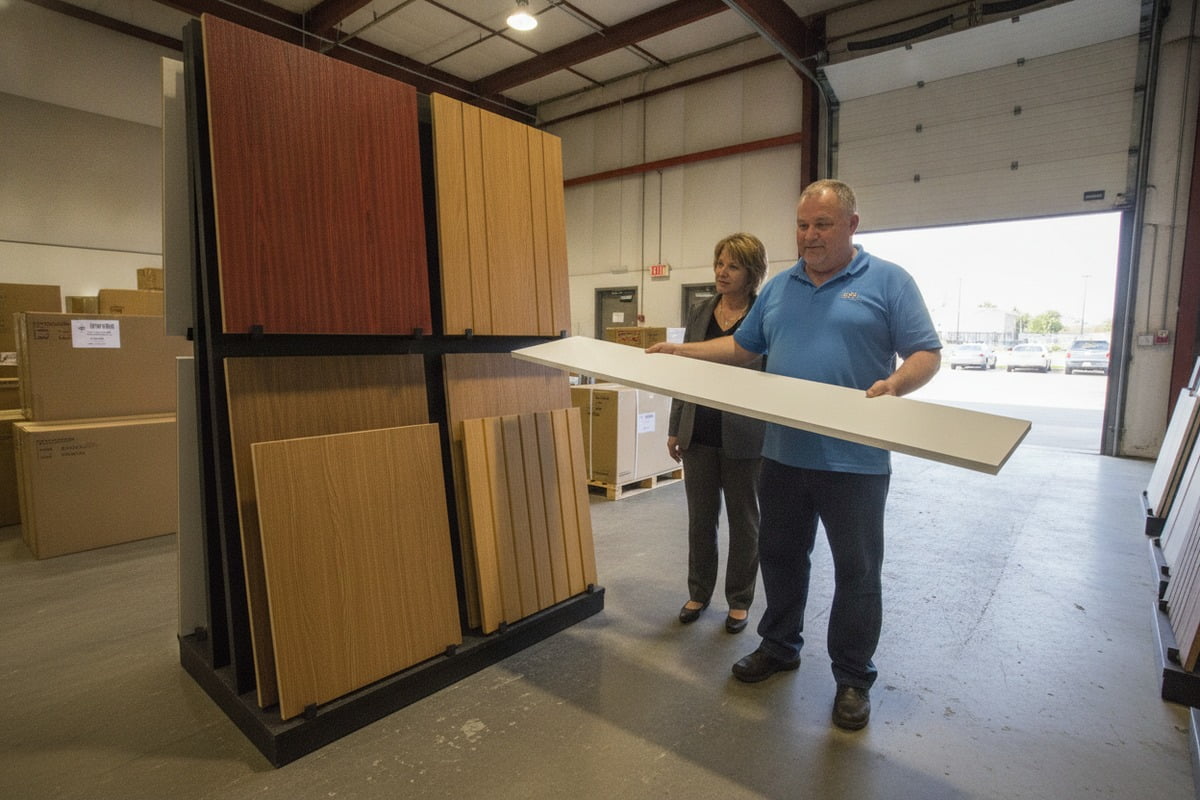
Fire rating standards vary by country. A panel certified under one system may not automatically qualify under another. Procurement professionals need to know which standard applies in their destination market and then request the corresponding test report. Here is a quick reference:
| Market / Region | Common Fire Standard | Key Rating to Request | Notes |
|---|---|---|---|
| European Union | EN 13501-1 7 | B-s1,d0 or C-s2,d0 | "s" = smoke, "d" = droplets |
| China (domestic) | GB 8624 | Class B1 (flame retardant) | Required for export documentation |
| United States | ASTM E84 8 | Class A (Flame Spread ≤ 25) | Tunnel test; many US projects require this |
| Latin America (varies) | Often references ASTM or EN | Depends on local municipality | Always confirm with local inspector |
| Middle East (UAE, Saudi) | BS 476 or EN 13501-1 | Class 0 or B-s1,d0 | Dubai Civil Defense often has extra requirements |
| India | IS 15491 / NBC 2016 | Class 1 surface spread of flame | Bureau of Indian Standards reference |
What Makes a Fire Test Report Trustworthy?
Not all test reports carry the same weight. When our team prepares documentation for a client, we make sure the report includes the following elements:
- Accredited laboratory name and logo — look for ISO 17025 accreditation 9.
- Test standard number and version — must match your local code.
- Sample description — should match the exact product SKU, thickness, and finish you are ordering. A report for a 7 mm matte white panel does not automatically cover an 8 mm high-gloss marble panel.
- Test date — some authorities reject reports older than two or three years.
- Classification result — clearly stated, not buried in an appendix.
We have seen competitors supply generic fire reports that cover a "PVC panel" without specifying which product line. This is a red flag. Professional procurement teams request that the test sample matches the purchase order specification precisely. If the supplier cannot provide this, it signals either that they have not tested the specific product or that they are repackaging a different factory's documentation.
Regulatory Compliance Beyond Fire
Fire rating is the most visible compliance requirement, but procurement specifications for commercial and hospitality projects increasingly include low-VOC emissions limits 10, REACH or RoHS documentation for chemical safety, and sometimes specific bans on heavy-metal stabilizers like lead or cadmium. Buyers sourcing for South American standards and certifications should pay particular attention to which local municipalities reference ASTM or EN frameworks. These requirements matter because they affect indoor air quality and because some customs authorities now screen for restricted substances. Our Zhejiang base uses calcium-zinc stabilizers instead of lead-based alternatives precisely to meet these export requirements without last-minute scrambling.
How can I optimize my product specifications to reduce shipping costs without compromising durability?
A trade-off we weigh on nearly every large order: our Bolivian distributor wanted the thickest, most premium panel possible, but ocean freight from Ningbo was eating into his margin. The real question was not "how thick can I go?" but "what is the lightest panel that still performs in my application?" This reframing saved him roughly 12% on container cost per shipment.
Optimize specifications by selecting the thinnest panel that meets your performance and code requirements, choosing standard lengths that maximize container packing density, consolidating SKUs to reduce wasted space, and specifying lightweight yet rigid formulations — all of which cut shipping weight and volume without sacrificing moisture resistance or durability.
The Weight-Volume Equation
Shipping costs for PVC ceiling panels are driven by two factors: gross weight and cubic volume. A standard 20-foot container holds approximately 28 cubic meters. A 40-foot container holds about 67 cubic meters. PVC panels are relatively light per piece, so container loading is usually limited by volume rather than weight. That means the way you stack and pack panels matters as much as the panel weight itself.
Here is a practical comparison showing how specification choices affect container loading:
| Specification Choice | 40ft Container Load (approx.) | Effect on Cost per m² |
|---|---|---|
| 250 mm × 7 mm × 2.95 m (standard) | ~2,800–3,200 m² | Baseline |
| 250 mm × 8 mm × 3.95 m (thicker, longer) | ~2,200–2,600 m² | +10–18% shipping cost per m² |
| 250 mm × 7 mm × 5.8 m (extra long) | ~2,400–2,800 m² | +5–10%, but fewer joints on site |
| 300 mm × 7 mm × 2.95 m (wider) | ~3,000–3,400 m² | Slight improvement due to fewer pieces |
| Mixed SKUs (3 finishes, 2 lengths) | ~2,000–2,500 m² | +15–25% due to packing gaps |
Three Practical Steps to Cut Freight Costs
1. Standardize your lengths. The most popular lengths in our order book are 2.95 m and 3.95 m. These dimensions fit well inside standard containers when stacked lengthwise. Custom lengths (say 3.2 m or 4.5 m) often create dead space at the container ends.
2. Limit your SKU mix per container. Every time you add a different panel width, thickness, or finish to the same container, you create packing complexity. Boxes of different sizes do not nest as tightly. Our logistics team consistently sees that single-SKU containers load 15–20% more product than mixed-SKU containers.
3. Specify panel weight targets alongside thickness. Instead of simply asking for "8 mm panels," specify "8 mm panels with a maximum linear weight of 1,000 g/m." This prevents the factory from using an overly dense formulation that adds shipping weight without meaningful performance benefit. For residential bathroom ceilings in humid climates, a 7 mm panel with proper density offers excellent moisture resistance and durability while keeping the container weight manageable.
Packaging Details That Buyers Overlook
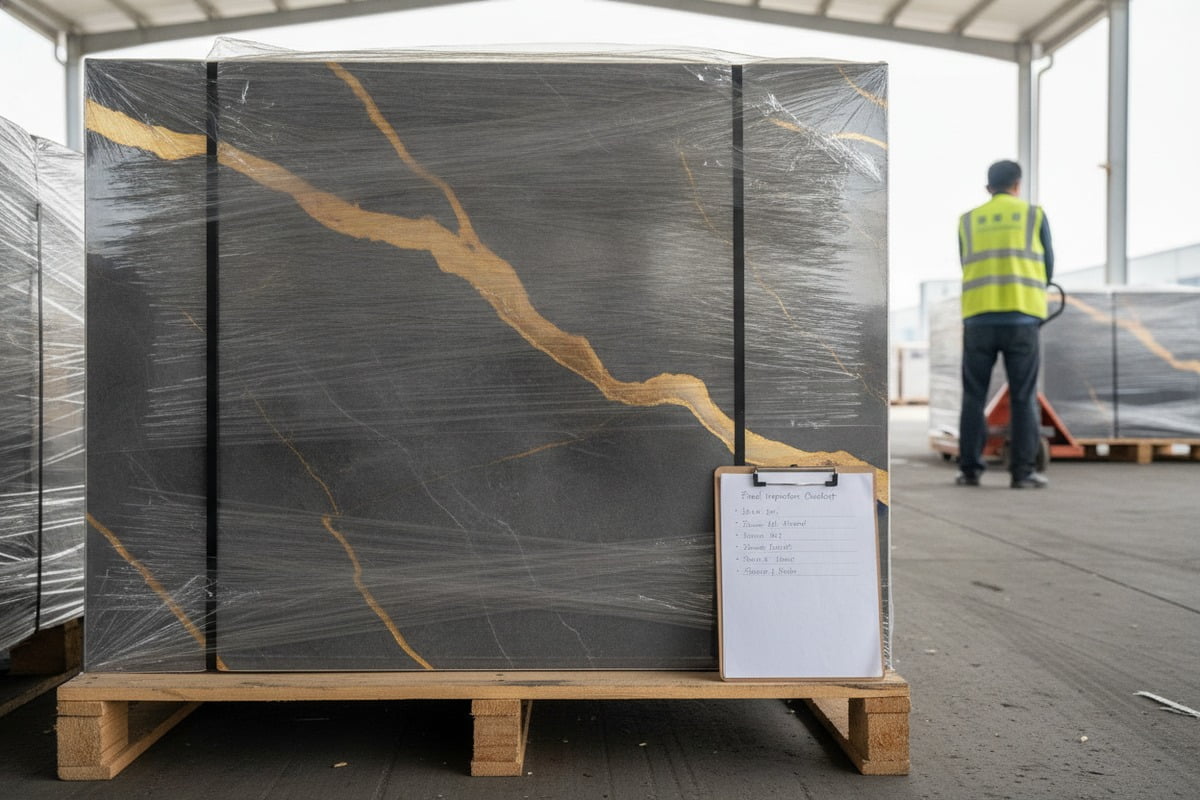
Packaging material itself adds weight and volume. Shrink-wrapped bundles without excessive cardboard spacers save space. But too little packaging causes transit damage. The sweet spot we have found is PE shrink film plus corner protectors, with lightweight cardboard dividers only between bundles — not between individual panels. This approach typically adds less than 3% to the gross volume while keeping damage claims under 0.5%.
What specific quality control benchmarks should I set for my OEM partner to ensure batch consistency?
During a recent pre-shipment inspection for a Middle Eastern client, our QC team caught a 0.3 mm thickness variance between two pallets of the same SKU. On paper, 0.3 mm sounds trivial. In practice, it meant the tongue-and-groove joints would not align flush, and the installer would see visible lip differences across the ceiling. We rejected the batch and re-extruded. That is the kind of discipline that separates a reliable OEM partner from a risky one.
Set quality control benchmarks covering dimensional tolerances (±0.2 mm thickness, ±1 mm length), color consistency (ΔE ≤ 1.5 between batches), surface defect limits (zero cracks, scratches, or stains per panel), fire rating documentation per SKU, and a defined inspection protocol at pre-production, in-line, and pre-shipment stages.

Building a QC Specification Sheet
A QC specification sheet is the single most important document you share with your OEM partner. It removes ambiguity. It gives both sides a measurable standard to reference if a dispute arises. Below are the benchmarks we recommend based on the orders we handle for regional distributors:
Dimensional Tolerances
| Parameter | Target | Acceptable Tolerance | Rejection Threshold |
|---|---|---|---|
| Panel thickness | 7.0 mm (example) | ±0.2 mm | Beyond ±0.3 mm |
| Panel width | 250 mm | ±0.5 mm | Beyond ±1.0 mm |
| Panel length | 2,950 mm | ±1.0 mm | Beyond ±2.0 mm |
| Straightness (bow) | 0 mm per meter | ≤1.0 mm per meter | Beyond 1.5 mm per meter |
| Tongue-and-groove fit | Flush, firm click | Slight hand pressure to engage | Gaps visible at joint line |
Color and Surface Quality
Color consistency is one of the biggest pain points in private-label resale. A distributor selling to a hotel chain cannot have one room's ceiling slightly yellower than the next. We use a spectrophotometer to measure ΔE (Delta E) between production batches. A ΔE of 1.0 or below is virtually invisible to the naked eye. A ΔE of 1.5 is the maximum most professional buyers accept. Anything above 2.0 is noticeable and should trigger a hold on shipment.
For surface quality, the standard is straightforward: no scratches, no cracks, no burrs, no stains, no warping, and no delamination of the printed or laminated finish. Each of these defects is inspected visually under consistent lighting conditions. Our inspectors check every bundle at the outermost panel and then randomly sample interior panels at a rate defined by AQL (Acceptable Quality Limit) 2.5 for critical defects and AQL 4.0 for minor cosmetic issues.
The Three-Stage Inspection Protocol
Professional procurement does not rely on a single final inspection. The most reliable approach uses three checkpoints:
Pre-production check: Confirm raw materials (resin batch, filler grade, stabilizer type, lamination film). Verify that the production line is calibrated to the correct die and profile. This stage catches problems before any material is wasted.
In-line inspection: After the first 10–20% of the order is extruded, an inspector measures dimensions, checks surface quality, and compares color to the approved sample. If there is drift, the line is adjusted immediately rather than after the full batch is complete.
Pre-shipment inspection: A full AQL sampling of the finished, packed goods. Dimensions, color, surface quality, packaging integrity, labeling accuracy, and carton markings are all verified. The fire test report and any compliance certificates are cross-checked against the purchase order.
What Happens When Benchmarks Are Not Met
This is where the contract language matters. Your purchase agreement with the OEM partner should spell out the consequences of failing QC: re-production at the supplier's cost, a negotiated discount for minor deviations accepted by the buyer, or outright rejection and replacement. Without these terms written down before production starts, you have no leverage. We build these clauses into every order confirmation we issue because we have seen how quickly disputes escalate when expectations are only verbal.
Maintenance Requirements and Long-Term Performance
Setting QC benchmarks is not just about the day the panels leave the factory. It is about how they perform for years. Properly manufactured PVC ceiling panels with verified hygienic panels properties should require only periodic wiping with a damp cloth. They should resist mold growth in bathrooms and kitchens. They should not yellow under normal indoor lighting. These long-term maintenance requirements trace directly back to the raw material quality and manufacturing consistency controlled during production. Buyers who skip QC end up paying for replacements, warranty claims, and damaged brand reputation downstream.
Installation methods also interact with quality benchmarks. Panels that are dimensionally inconsistent create problems with suspended ceiling systems and furring strip alignment. A panel that is 0.5 mm too wide will bind in the groove. One that is 0.5 mm too narrow will rattle. These tolerances matter most when a contractor installs thousands of square meters and expects every piece to click together without trimming or forcing.
Conclusion
PVC ceiling requirements are a specification exercise, not a shopping exercise. Define your PVC content, thickness, fire rating, moisture resistance, and QC benchmarks before comparing prices. Treat cost-effectiveness as an outcome of smart specs — not a starting point. Once your specifications are locked in, you can evaluate if a PVC ceiling supplier quote is reasonable with confidence. Precise requirements protect your margins and your reputation in every market you serve.
Footnotes
1. Explains REACH and RoHS compliance requirements, including documentation and differences. ↩︎
2. Defines dimensional tolerances and their impact on manufacturing, quality, and production efficiency. ↩︎
3. Provides an overview of PVC resin, its properties, and applications. ↩︎
4. Discusses the benefits and superiority of virgin PVC over recycled PVC in terms of durability and consistency. ↩︎
5. Explains PVC K-value, its meaning, calculation, and impact on properties and processing. ↩︎
6. Defines apparent density as a fundamental parameter for construction materials, including pores and moisture. ↩︎
7. Explains the European standard for fire classification of construction products and building elements. ↩︎
8. Details the ASTM E84 standard test method for surface burning characteristics of building materials. ↩︎
9. Details ISO/IEC 17025 competency requirements for testing and calibration laboratories. ↩︎
10. Discusses the importance of low-VOC emissions for indoor air quality in green and sustainable buildings. ↩︎



0 Comments