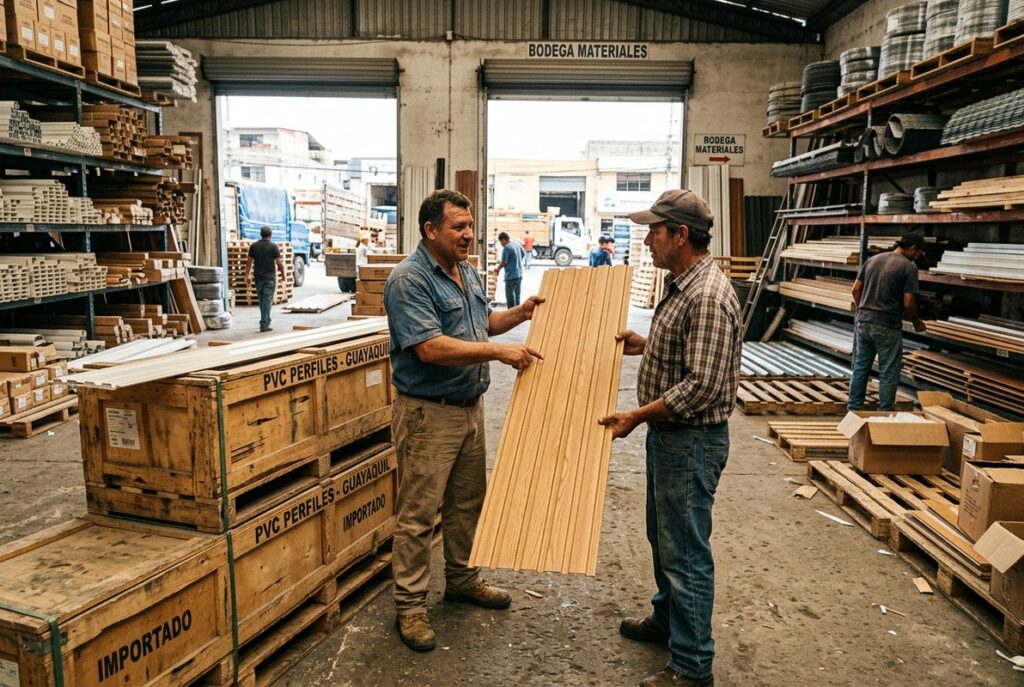
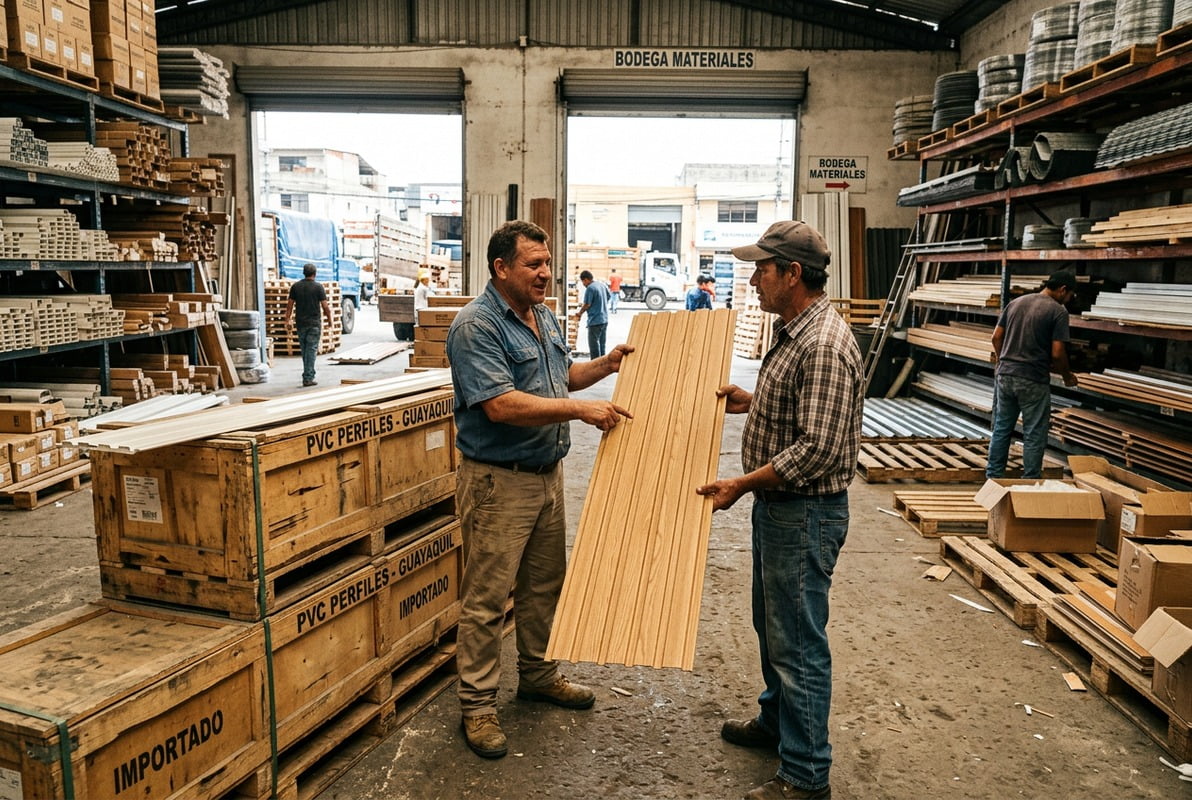
Every time our sales team reviews order data from Latin American clients, one question keeps coming back: which PVC ceiling patterns actually move volume in that market?
South American distributors should prioritize textured wood grain finishes, marble-look panels, and classic pure white PVC ceilings. These three pattern families dominate regional demand because they deliver premium aesthetics at budget-friendly prices while resisting the humidity, mold, and termite damage common across tropical climates.
The answer sounds simple, but the details matter textured wood grain finishes 1. Choosing the wrong texture or finish can leave containers sitting in your warehouse. This guide breaks down current trends, profit margins 2, climate performance, and customization options so you can stock what actually sells.
How do I identify which wood-grain or marble textures are currently trending in the Latin American market?
A few months ago, one of our long-term distributors in Ecuador sent photos of a competitor's showroom tropical climates 3. Every best-seller on display was either a warm honey-oak panel or a Calacatta marble lookalike. That confirmed what our order books had been telling us for two quarters straight.
Wood-grain textures in natural oak and dark walnut tones, plus white-veined marble patterns, are the top trending PVC ceiling textures in Latin America right now. Neutral palettes—white, beige, and light gray—remain steady sellers, while bold accent colors are growing in commercial ceiling applications.
Why Wood Grain Dominates
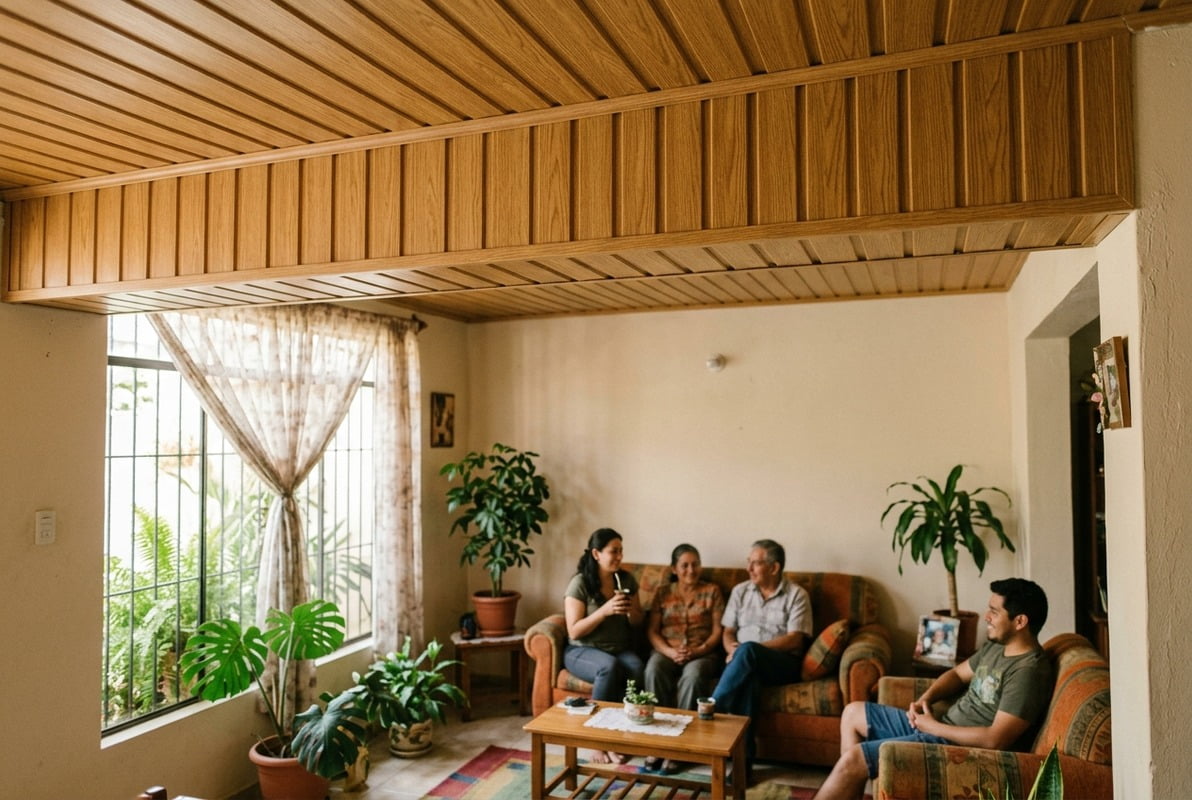
Wood grain finishes tap into a universal desire for warmth. Real wood ceilings cost significantly more, weigh more, and rot in humid environments. PVC panels printed with realistic wood textures solve all three problems. In our production line, we use high-definition digital printing 4 and embossed roller technology to create surfaces that look and feel like actual timber. The result is a decorative ceiling tile that passes the visual test at arm's length.
Light oak and honey-toned finishes are the highest-volume SKUs we ship to Colombia and Bolivia. Dark walnut and espresso tones sell well for commercial projects—restaurants, hotel lobbies, and retail stores. The key takeaway: stock both light and dark wood grain finishes to cover residential ceiling solutions and commercial ceiling applications 5.
Marble Textures: The Luxury Play
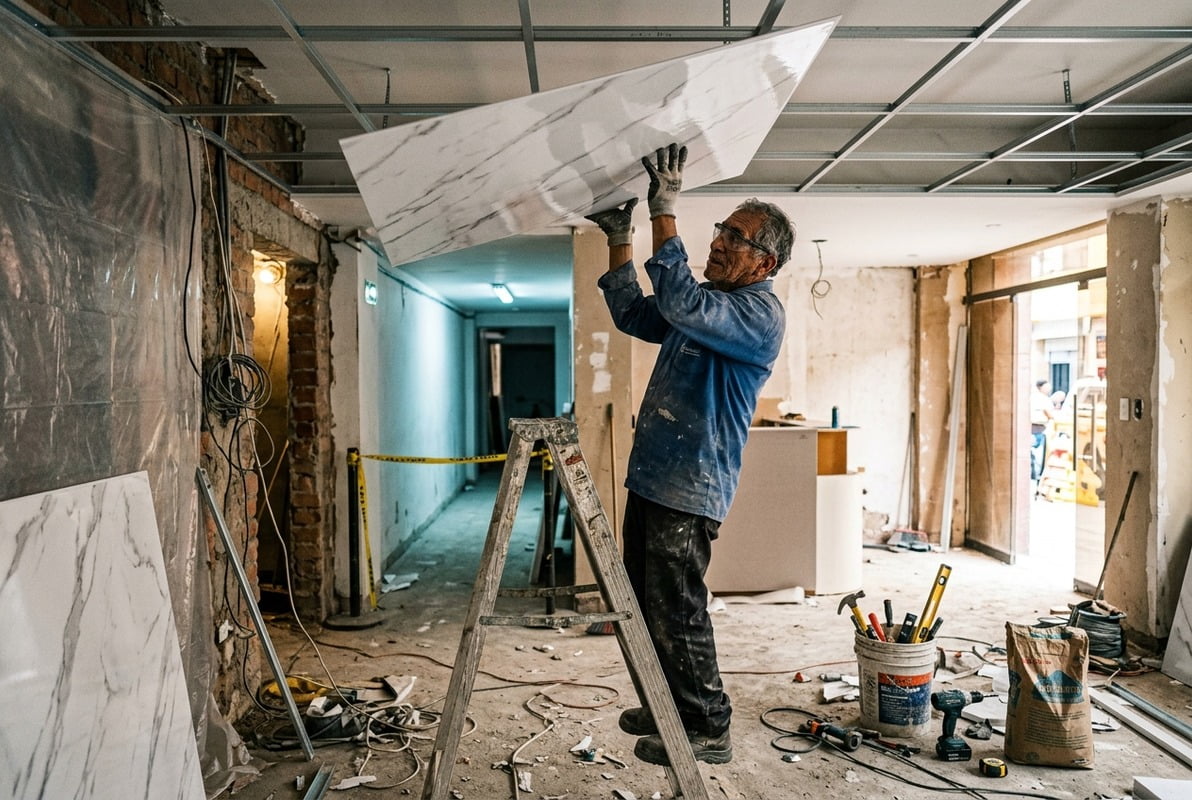
Marble-look panels serve a different buyer. They target mid-to-upper-tier renovations where the client wants a sophisticated ceiling but cannot afford real stone. White marble with gray veining is the single most requested marble pattern across our Latin American accounts. Darker marble options—nero marquina, emperador—move in smaller quantities but at higher unit prices.
Trend Snapshot: What to Stock First
| Pattern Family | Top Colors / Variants | Primary End Use | Demand Trend (2025–2026) |
|---|---|---|---|
| Wood Grain | Light oak, honey oak, dark walnut | Residential ceilings, bedrooms, living rooms | Strong and rising |
| Marble | White Calacatta, gray vein, nero marquina | Commercial lobbies, bathrooms, kitchens | Steady growth |
| Pure White / Neutral | Matte white, glossy white, warm beige | Offices, clinics, budget renovations | Consistently high volume |
| 3D Dual-Groove | White, light gray, light wood tone | Modern apartments, retail spaces | Emerging trend |
Reading the Signals
How do you spot what is trending before it saturates your market? Track three things. First, monitor social media platforms popular in your region—Instagram and TikTok accounts of local interior designers. Second, request sample feedback from your top ten retail clients every quarter. Third, watch what your China-based supplier is producing in high volume. When our Zhejiang base increases a particular mold's run time, it usually means orders from multiple markets are converging on that pattern.
Forty percent of designers globally now endorse textured surfaces as the primary way to enhance interior spaces. That statistic aligns perfectly with what we see in Latin American orders: textured panels outsell flat, plain panels by a wide margin. If you are a distributor deciding where to place your next container order, lead with wood grain finishes, support with marble, and fill the gaps with matte white neutrals.
Which high-gloss or matte PVC ceiling patterns will offer my distribution business the highest profit margins?
During a pricing negotiation last quarter, a wholesale buyer in Colombia asked me a direct question: "Which finish gives me better margins—glossy or matte?" The answer surprised him, because it depends on more than just the surface.
Matte-finish PVC ceiling panels currently offer higher profit margins for South American distributors because they command premium positioning, align with 2026 design trends favoring understated textures, and cost only marginally more to produce than standard glossy panels—yet retail at noticeably higher prices.
The Margin Math: Gloss vs. Matte
Profit margin is not just about cost. It is about the gap between your landed cost and what the local market will pay. High-gloss panels have been common for years. Buyers see them as a commodity. Matte panels, especially those with embossed textures, feel newer and more sophisticated. That perception lets you price them higher.
Here is a simplified comparison based on typical container economics:
| Factor | High-Gloss Panels | Matte / Textured Panels |
|---|---|---|
| FOB Unit Cost | Baseline | 5–10% above baseline |
| Typical Wholesale Markup | 25–35% | 35–50% |
| Perceived Value by End User | Standard, familiar | Premium, modern |
| Competition Level | High (many suppliers) | Moderate (fewer options) |
| Return / Complaint Rate | Higher (scratches show easily) | Lower (texture hides minor marks) |
The numbers tell a clear story. Matte and textured panels may cost slightly more per square meter at the factory gate, but your ability to mark them up is significantly greater. They also generate fewer returns because the textured surface hides fingerprints, minor scratches, and dust far better than a mirror-like gloss finish.
Where Glossy Still Wins
Do not abandon glossy panels entirely. High-gloss white ceilings remain the go-to product for budget-conscious buyers renovating rental apartments, small shops, and clinics. They are low maintenance ceilings that reflect light well and make small rooms appear larger. In price-sensitive segments, glossy white is still a volume driver. The trick is to use glossy as your entry-level product and matte textures as your premium upsell.
3D Ceiling Designs: The Margin Multiplier
The newest margin opportunity is 3D dual-groove panels. These panels feature parallel grooves pressed into the surface to create a modern, architectural look. They function as suspended ceiling alternatives in spaces where a traditional grid system is impractical. Because 3D ceiling designs are still relatively new in many South American cities, early distributors can set the price before competition drives it down. We have seen distributors in Ecuador achieve 45–55% gross margins on 3D groove panels during the first year of introduction.
A Practical Stocking Strategy
Blend your container to balance volume and margin. A common split we recommend: 50% matte wood grain and marble textures, 30% glossy white and neutral panels, and 20% 3D groove or specialty designs. This mix ensures you capture both the high-volume, low-margin segment and the lower-volume, high-margin segment. To make sure you are paying a fair price for each segment, it helps to evaluate if a PVC ceiling supplier quote is reasonable before committing to large orders.
Can I find textured PVC panels that withstand the high humidity levels common in my region?
One lesson we learned early when exporting to coastal cities in Latin America: a beautiful ceiling panel means nothing if it warps, blisters, or grows mold within a year. Climate performance is not optional—it is the baseline requirement.
Yes, high-quality textured PVC panels are inherently waterproof and mold resistant, making them ideal for South America's humid and tropical climates. Unlike natural wood or standard gypsum, PVC does not absorb moisture, swell, or support mold growth, and fire-resistant formulations add an extra layer of safety for commercial projects.

How PVC Handles Humidity
PVC—polyvinyl chloride 6—is a synthetic polymer. It does not have pores like wood. It does not dissolve like paper-faced gypsum when exposed to water vapor. This is why waterproof ceiling panels made from PVC outperform nearly every traditional ceiling material in high-humidity environments. In cities like Guayaquil, Barranquilla, or Santa Cruz, where relative humidity regularly exceeds 80%, this matters enormously.
Our panels are extruded under controlled conditions at the Zhejiang base. The extrusion process 7 creates a closed-cell structure that blocks moisture penetration. After extrusion, the surface receives either a lamination film or a digital print layer. Both are sealed to prevent water ingress.
Comparing Ceiling Materials in Humid Climates
| Property | PVC Panels | Gypsum Board | Natural Wood | Mineral Fiber Tiles |
|---|---|---|---|---|
| Moisture Resistance | Excellent | Poor | Poor to moderate | Moderate |
| Mold Resistance | Excellent (mold resistant material) | Low | Low | Moderate |
| Termite Resistance | Immune | N/A | Vulnerable | N/A |
| Weight | Lightweight | Heavy | Heavy | Moderate |
| Installation Speed | Fast (easy installation) | Moderate | Slow | Moderate |
| Fire Rating | B1 (fire-resistant panels available) | A2 | Combustible | A1–A2 |
| Maintenance | Wipe clean (low maintenance ceilings) | Repaint / replace | Sand, seal, repaint | Replace stained tiles |
Beyond Moisture: Termites and Salt Air
Two other environmental threats plague South American buildings. Termites attack wood ceilings and framing, especially in tropical lowlands. PVC is completely immune to termite damage. Coastal cities also deal with salt-laden air that corrodes metal and degrades organic materials. PVC resists salt corrosion, making it a reliable choice for seaside hotels, beach restaurants, and port-area warehouses.
Fire Safety and Compliance
Commercial projects in many South American countries require ceiling materials to meet fire-retardant standards. Our production team adds fire-retardant additives during the PVC compounding stage. The resulting panels achieve B1 fire classification 8, which satisfies most local building codes. We provide fire-retardant test reports with every shipment—something that matters deeply to distributors who supply contractors working on hotels, hospitals, and government buildings. For a deeper look at the standards and certifications that apply when sourcing PVC ceilings from China, we have a dedicated guide covering regional compliance requirements.
Acoustic and Thermal Benefits
PVC ceiling panels also provide a degree of acoustic dampening and thermal insulation. The hollow-core design of many panel profiles traps a layer of air between the panel face and the structural ceiling above. This air gap reduces sound transmission and helps regulate indoor temperature. For distributors selling into residential ceiling solutions, these functional benefits are strong selling points beyond aesthetics.
The bottom line: every textured, wood grain, marble, or 3D pattern we produce is engineered to handle the worst that South American climates can throw at it. You do not have to choose between beauty and durability.
How can I customize unique ceiling patterns to differentiate my brand from other local wholesalers?
When a distributor in Bolivia told me his biggest fear was that three other importers in his city were selling the exact same white glossy PVC panel, I understood the urgency. Differentiation is survival in a crowded wholesale market.
Distributors can differentiate through OEM customization: digital printing enables unique wood grain, marble, geometric, and even biophilic patterns exclusive to your brand. Combined with private-label packaging and custom panel dimensions, this approach turns a commodity product into a proprietary offering that competitors cannot easily replicate.

Digital Printing: The Game Changer
Digital printing technology has transformed what is possible with decorative ceiling tiles. Traditional PVC panel decoration relied on hot-stamping foils. The catalog of available foils was limited—maybe 30 to 50 designs. If your competitor bought the same foil, your panels looked identical.
Digital printing removes that constraint. Our production facility can print virtually any high-resolution image onto a PVC panel surface. A distributor can send us a photograph of a specific wood species native to their country, and we can reproduce it on the panel. Biophilic patterns 9—designs that incorporate local flora, leaf textures, or organic shapes—are a growing category that resonates with South American buyers who value connection to nature.
Steps to Create a Custom Pattern
Here is the process we follow with distributors who want exclusive designs:
- Design consultation — The distributor shares mood boards, competitor samples, or original artwork. Our design team evaluates printability.
- Digital proof — We create a high-resolution digital mockup showing the pattern on a panel. The distributor approves or requests changes.
- Sample production — A small batch of physical samples is produced and shipped for tactile evaluation. The distributor checks color accuracy, texture alignment, and finish quality.
- MOQ agreement — Custom patterns typically require a minimum order quantity. For digital printing, this can be as low as 500 square meters, far less than traditional foil runs.
- Full production and QC — Panels enter mass production. Our quality control team checks every batch for color consistency, adhesion strength, and dimensional accuracy.
- Private-label packaging — Panels are packed in boxes printed with the distributor's own brand name, logo, and product specifications.
What You Can Customize
Not just the pattern. Distributors can customize multiple elements to build a genuinely unique product line. Understanding how procurement professionals define PVC ceiling requirements and specifications can help you communicate your customization needs more effectively to your supplier:
- Surface pattern: Wood grain, marble, geometric, abstract, cultural motifs
- Finish type: Matte, semi-gloss, high-gloss, soft-touch
- Panel width: 250 mm, 300 mm, 400 mm, or custom widths
- Panel length: Standard 2.95 m, 3.0 m, 3.8 m, 5.8 m, or cut-to-order
- Edge profile: Flat joint, V-groove, dual groove for 3D ceiling designs
- Functional coatings: Antimicrobial, anti-static, UV-resistant
Addressing the Sustainability Question
Some buyers and end users raise concerns about PVC's environmental impact. It is a valid point. PVC production involves chlorine chemistry, and disposal requires proper handling. However, the industry is moving forward. Antimicrobial coatings reduce the need for chemical cleaning agents over the panel's lifetime. Some formulations now incorporate recycled PVC content. And because PVC ceilings last 15–20 years without replacement, the long lifecycle offsets much of the initial environmental cost compared to materials that need frequent repainting or replacement.
For distributors who want to lean into sustainability messaging, we can help source panels with verified recycled content and provide documentation for green building certifications 10. This is not just good ethics—it is a competitive differentiator in markets where environmental awareness is growing among architects and project developers.
The Brand-Building Payoff
When you sell the same panel as every other wholesaler, you compete on price alone. When you sell a panel with a pattern that only your brand carries, you compete on value. Customization costs more per unit at the start, but it protects your margins over time and builds customer loyalty. Several of our Latin American partners now have exclusive pattern libraries with 15 to 20 designs that no one else in their country can source.
Conclusion
South American distributors who prioritize wood grain finishes, marble textures, matte neutrals, and 3D ceiling designs will capture the strongest demand. Pair those choices with climate-resistant performance and private-label customization to build lasting margins.
Footnotes
1. Explores current woodgrain trends in interior design, including the popularity of textured finishes. ↩︎
2. Wikipedia offers a clear and authoritative definition of profit margins, suitable for a general explanation. ↩︎
3. Provides a concise definition and characteristics of tropical climates, including high temperatures and humidity. ↩︎
4. Explains the technology and benefits of high-definition digital printing for creating detailed and vibrant images. ↩︎
5. This article provides a comprehensive guide to various types of commercial ceilings and their applications, directly addressing the anchor text. ↩︎
6. Wikipedia is an authoritative source for defining scientific and technical terms like polyvinyl chloride, providing a comprehensive overview. ↩︎
7. Describes the plastic extrusion manufacturing process, where polymer material is melted and continuously formed. ↩︎
8. This article clearly explains the B1 fire resistance classification, which is a European fire rating, aligning with the context of the original anchor. ↩︎
9. Outlines the 14 patterns of biophilic design, which integrate natural elements and patterns into built environments. ↩︎
10. Provides an overview of various high-performance green building certification systems and their assessment criteria. ↩︎



0 Comments