

Every week, our production lines ship PVC ceiling panels to distributors in Panama, Colombia, and Peru SGS certifications 1. The most common frustration we hear from new buyers is not a lack of options—it is the overwhelming number of suppliers that all look the same online. Sorting through hundreds of listings, each promising low prices and high quality, creates real sourcing anxiety V-Trust 2. The risk of choosing wrong is not just wasted money. It is damaged panels arriving at port, missed project deadlines, and lost trust with your own customers.
South American distributors can find reliable Chinese PVC ceiling suppliers by combining B2B platform screening, factory credential verification, product sample testing, logistics planning, and clear communication of custom design requirements—prioritizing consistency, export experience, and compliance documentation over the lowest unit price alone.
This guide walks you through a practical, step-by-step process. Each section below tackles one critical piece of the sourcing puzzle so you can build a repeatable workflow that reduces risk and protects your margins. Let us start with the most fundamental question: how do you know the factory behind the listing is real?
How do I verify the factory credentials of a Chinese PVC ceiling manufacturer?
We have seen distributors lose entire container deposits because they trusted a polished website without checking the basics behind it. Fake factories, rebranded trading companies, and middlemen with no production capacity are real risks in this market.
Verify factory credentials by cross-checking business registration documents, requesting recent third-party audit reports such as ISO or SGS certifications, confirming the physical factory address through video calls or inspection agents, and asking for verifiable export references from Latin American buyers.
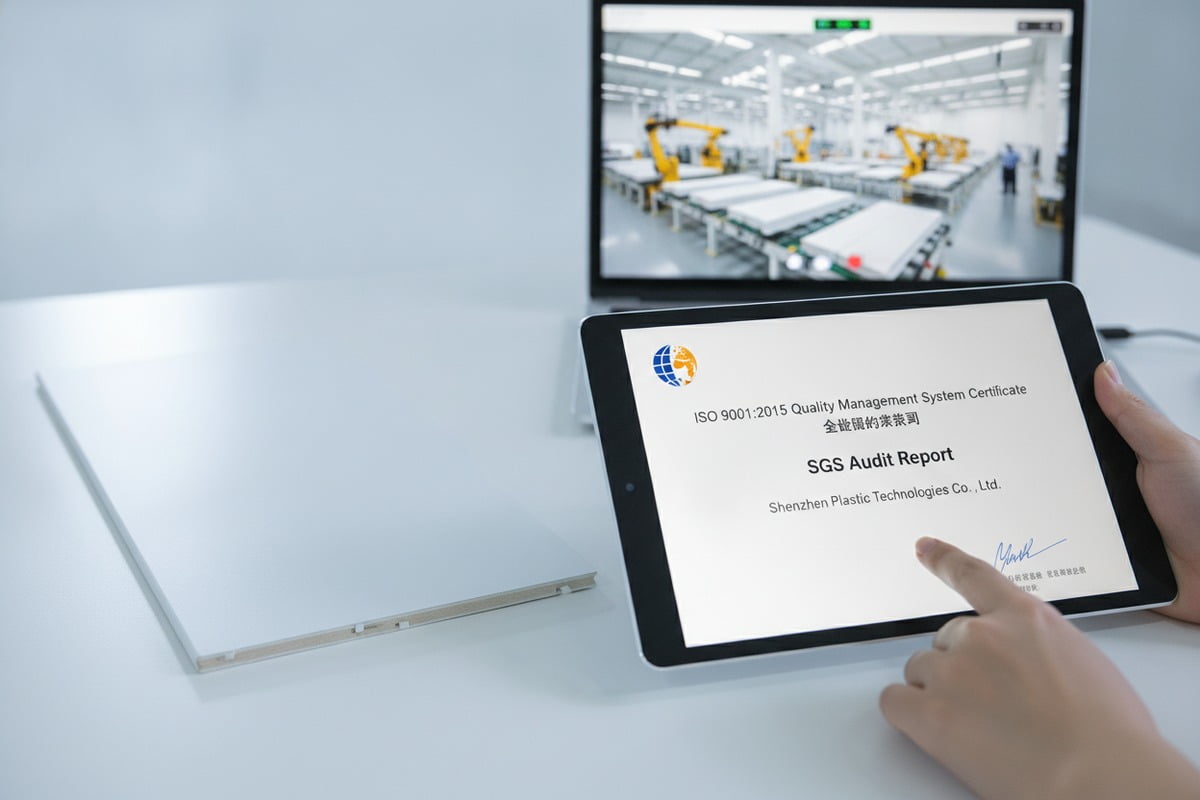
Start With Business Registration
Every legitimate Chinese manufacturer has a business license issued by the local government. Ask the supplier for their营业执照 (yíngyè zhízhào), which is their official Chinese business registration. You can verify this number on the National Enterprise Credit Information Publicity System 3. The registration will tell you the company's legal name, registered capital, founding date, and business scope. If PVC building materials are not listed in their scope, that is a red flag.
Distinguish Factories From Trading Companies
This is one of the biggest traps in Chinese sourcing. A trading company 4 may have a beautiful showroom but zero production equipment. Here is a quick comparison to help you tell them apart:
| Indicator | Real Factory | Trading Company |
|---|---|---|
| Factory address on registration | Matches industrial zone | Often a commercial office |
| Production equipment photos | Specific, detailed machinery | Generic or stock images |
| MOQ flexibility | Less flexible, prefers larger runs | Very flexible, any quantity |
| Price negotiation range | Narrower margins | Wider margins (markup built in) |
| Technical questions | Answered quickly by engineers | Delayed or vague responses |
| Video call of production line | Readily available | Often declined or delayed |
A trading company is not always bad. Some add value through quality control and logistics support. But you need to know what you are dealing with so you can price and plan accordingly.
Use Third-Party Verification
Request ISO 9001 certification 5 for quality management systems. Ask for SGS, TÜV, or Bureau Veritas 6 inspection reports. These third-party audits cost money, and a supplier willing to invest in them signals seriousness. You can also hire inspection companies like QIMA 7 or V-Trust to conduct a factory audit before you place your first order. A basic audit costs between $300 and $500 and can save you tens of thousands in bad shipments.
Check Export History
Ask the supplier for bill of lading records 8 or photos of past container shipments to South America. Suppliers who regularly export to Panama, Colombia, Chile, or Peru will understand the documentation your customs authority requires. They will also know how to pack panels for long ocean transit through humid conditions. If a supplier has never shipped to your country, expect a steeper learning curve on both sides.
Verify Through Multiple Channels
Do not rely on a single platform. If you found a supplier on Alibaba, also check their listing on Made-in-China or GlobalSources. Visit their company website. Search their company name on Google. Check if they have a presence on social media. Cross-referencing reduces the chance of being misled by a single curated profile.
What quality standards should I check for to ensure my PVC ceilings are durable?
On our production floor, we run daily batch tests for thickness tolerance, color consistency, and interlocking fit. But not every factory does this. When panels arrive in a tropical South American warehouse and start warping or yellowing within weeks, the distributor is the one who takes the blame—not the Chinese factory.
Check for compliance with ISO 9001 quality management, CE marking, SGS material testing, and specific performance standards covering thickness tolerance, water absorption rate, flame retardancy, color fastness, and interlocking precision to ensure PVC ceiling panels withstand South American climate conditions.
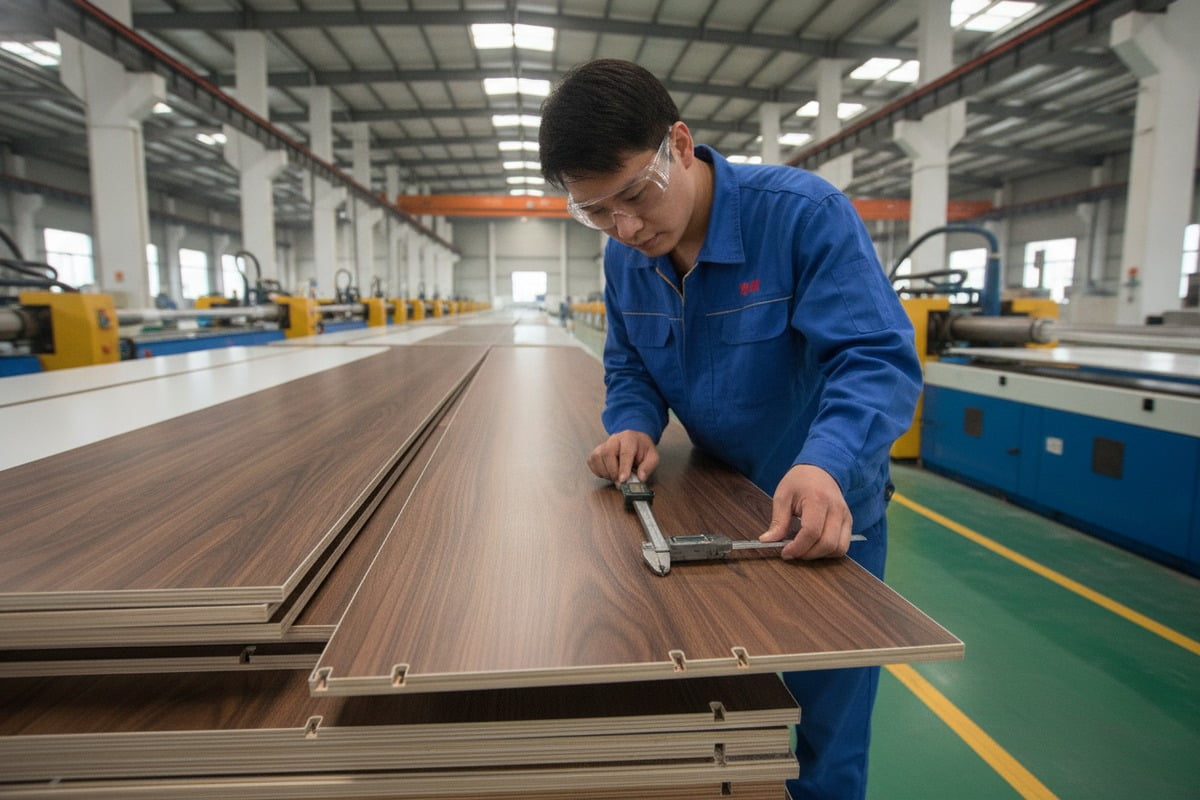
Key Performance Specifications
PVC ceiling panels used in South America must handle heat, humidity, and UV exposure. Here are the critical specs you should request from any supplier:
| Specification | Recommended Standard | Why It Matters |
|---|---|---|
| Thickness | 7mm – 10mm (±0.2mm tolerance) | Thin panels sag; inconsistent thickness causes uneven installation |
| Water absorption | ≤ 1% after 24-hour immersion | High absorption causes swelling and mold in humid climates |
| Flame retardancy | Class B1 (China) or Class 1 (EU) | Required by building codes in many South American countries |
| Color fastness | Grade 6–8 (grey scale) | Prevents yellowing and fading under UV exposure |
| Surface hardness | ≥ 2H pencil hardness | Resists scratches during transport and installation |
| Interlocking fit | Gap ≤ 0.3mm after assembly | Ensures seamless appearance on installed ceilings |
| Formaldehyde emission | E0 or E1 grade | Protects indoor air quality; increasingly regulated |
Why Samples Are Non-Negotiable
Never skip the sample stage. Order at least three to five panels from each shortlisted supplier. When the samples arrive, test them yourself. Bend them gently to check flexibility versus brittleness. Soak one in water for 24 hours. Leave another in direct sunlight for a week. Snap two panels together and check the joint tightness. Smell the panel—a strong chemical odor suggests excessive plasticizer content or recycled PVC.
Understand the Difference Between Virgin and Recycled PVC
This is a critical quality factor. Virgin PVC resin produces panels with better color consistency, higher impact resistance, and longer lifespan. Recycled PVC can reduce costs but often leads to brittleness, odor, and color variation between batches. Ask your supplier directly: what percentage of recycled content is in your panels? A trustworthy factory will give you a straight answer.
Climate Suitability for South America
Panels destined for coastal cities like Cartagena, Guayaquil, or Lima face salt air, high humidity, and intense sun. Panels for higher-altitude cities like Bogotá or Quito face different stresses. Make sure your supplier understands the end-use environment. Request data sheets that include performance under tropical conditions. If the supplier cannot provide this data, they may not have tested their product for your market.
Batch Consistency Matters More Than Single-Sample Quality
A single great sample means nothing if the next 10,000 panels look different. Ask for photos and test reports from at least three recent production batches. Consistent quality across batches is the hallmark of a well-managed factory with proper raw material controls, extruder calibration, and in-line quality checks.
How can I manage my shipping logistics and import duties from China to South America?
Our logistics team coordinates dozens of container shipments each month to Latin American ports. The lesson we have learned through years of doing this is simple: the cheapest FOB price means nothing if your landed cost eats your margin or your panels arrive damaged after 35 days at sea.
Manage logistics by partnering with a freight forwarder experienced in China-to-South America routes, choosing the right Incoterms (FOB, CIF, or DDP), calculating your full landed cost including freight, insurance, customs duties, and local taxes, and specifying packaging standards that protect panels during long ocean transit.
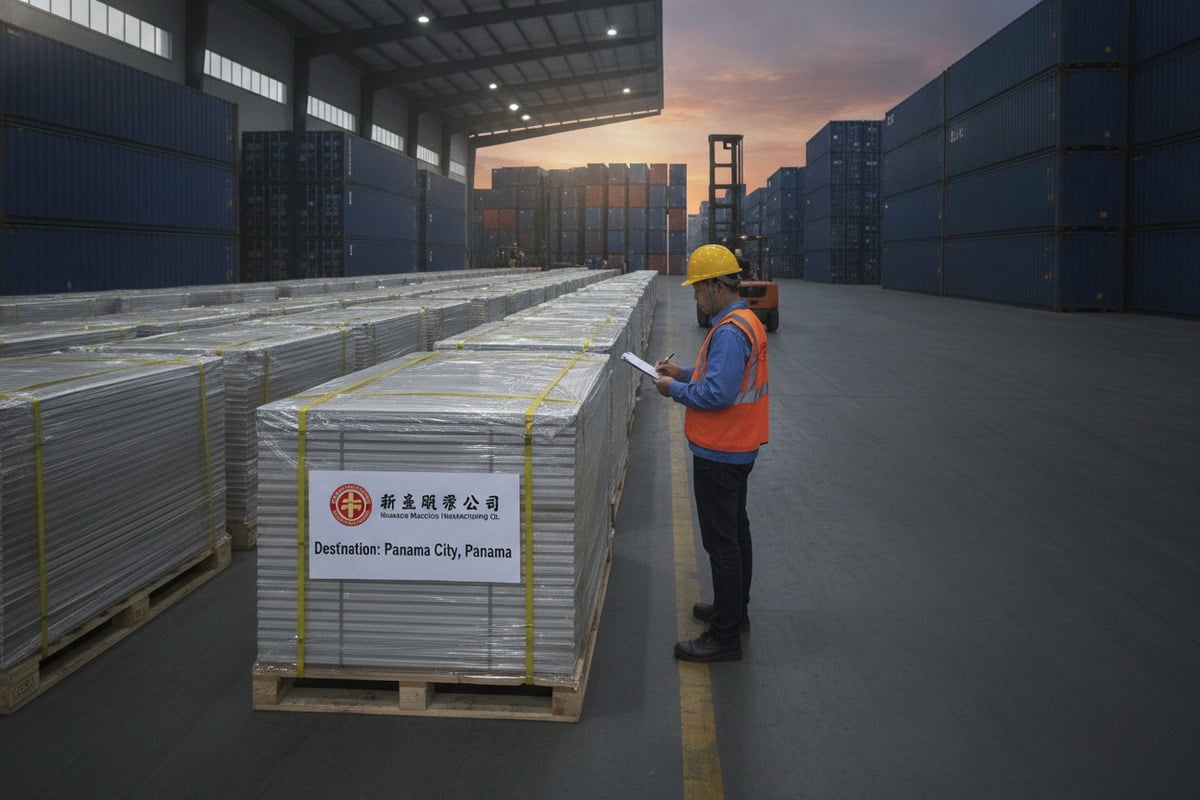
Calculate Your Full Landed Cost
Many first-time importers focus only on the unit price quoted by the supplier. This is a mistake. Your actual cost includes many more components:
| Cost Component | Typical Range | Notes |
|---|---|---|
| FOB unit price | $1.50 – $4.50 per sqm | Varies by thickness, finish, and order volume |
| Ocean freight (20ft container) | $2,000 – $5,500 | Depends on origin port, destination, and season |
| Marine insurance | 0.3% – 0.5% of cargo value | Covers loss and damage during transit |
| Customs duty | 5% – 20% of CIF value | Varies by country; check your HS code 9 |
| VAT / local tax | 12% – 19% | Applied on top of CIF + duty in most countries |
| Port handling and clearance | $200 – $800 | Includes unloading, documentation, and broker fees |
| Inland trucking | $100 – $1,000+ | Depends on distance from port to warehouse |
Add all of these together to get your true landed cost per square meter. Only then can you compare suppliers meaningfully.
Choose the Right Incoterms
FOB (Free on Board) 10 means the supplier delivers the goods to the ship at the Chinese port, and you take responsibility from there. CIF (Cost, Insurance, and Freight) means the supplier arranges shipping and insurance to your destination port. DDP (Delivered Duty Paid) means the supplier handles everything, including customs and delivery to your door.
For most South American distributors, CIF is a practical starting point. It lets you compare total delivered costs across suppliers easily. As your volume grows and you build relationships with freight forwarders, switching to FOB gives you more control over shipping costs.
Packaging for Long-Distance Ocean Freight
PVC ceiling panels are lightweight but can be damaged by moisture, compression, and shifting during a 25- to 40-day ocean voyage. Specify these packaging requirements to your supplier:
- Shrink-wrap each bundle of panels.
- Use reinforced cartons with moisture-resistant lining.
- Stack cartons on pallets with corner protectors.
- Secure pallets with strapping inside the container.
- Place desiccant bags inside the container to absorb moisture.
If the supplier pushes back on these requirements, take it as a warning sign. A factory experienced in long-haul exports will already know these steps.
Work With a Specialized Freight Forwarder
Find a freight forwarder who regularly handles shipments from Chinese ports (Shenzhen, Ningbo, Shanghai) to your destination (Callao, Buenaventura, Manzanillo, Santos). They will handle booking, documentation, customs brokerage, and troubleshooting. Ask your supplier for freight forwarder recommendations as well—they often have partners who offer competitive rates on familiar routes.
Understand Your Country's HS Code and Duty Structure
PVC ceiling panels typically fall under HS code 3925.90 or 3918.10, depending on the specific product type and country classification. Confirm the correct code with your customs broker before shipping. Using the wrong code can trigger delays, penalties, or incorrect duty rates.
What steps should I take to ensure my Chinese supplier understands my custom design requirements?
When we work with distributors who want a specific wood-grain pattern, a particular panel width, or private-label packaging, the projects that go smoothly are always the ones where the buyer communicated requirements clearly from day one. The projects that go wrong almost always trace back to vague instructions, assumed understanding, or skipped approval steps.
Ensure your supplier understands custom design requirements by providing detailed written specifications with dimensions, colors, finishes, and packaging artwork, requesting 3D renderings or physical pre-production samples for approval, confirming all details through a signed specification sheet, and maintaining regular communication via WhatsApp or video calls throughout production.

Create a Detailed Product Specification Document
Do not describe your needs only in words. Create a visual specification document that includes:
- Exact panel dimensions (length, width, thickness) in millimeters.
- Surface finish type (glossy, matte, satin, textured).
- Color reference (Pantone code, RAL code, or a physical sample).
- Design pattern (wood grain, marble, solid, or custom print).
- Edge profile (tongue-and-groove type, V-groove, flat edge).
- Packaging requirements (carton size, labels, branding, language on the box).
- Installation instructions to be included, if any.
The more specific you are upfront, the fewer revision rounds you will need later. Our engineering team always appreciates receiving a one-page spec sheet with labeled diagrams rather than a long email with scattered descriptions.
Request Pre-Production Samples
After your supplier confirms they can meet your specifications, request a pre-production sample. This is not the same as a standard catalog sample. A pre-production sample is made specifically to your custom requirements. Inspect it for:
- Accurate color match against your Pantone or RAL reference.
- Correct dimensions within the agreed tolerance.
- Surface finish quality and consistency.
- Interlocking fit with existing panels if you are adding to an existing product line.
- Print quality and alignment for patterned designs.
Sign off on the sample formally. Keep one as a reference standard and send one back to the factory to be stored as the production benchmark.
Use Visual Communication Tools
Language barriers are real. Even if your supplier has English-speaking sales staff, technical details can get lost in translation. Use these tools to bridge the gap:
- Annotated photos: Mark up images of existing products with arrows and notes showing exactly what you want changed.
- Video calls: Walk through your requirements on a screen share. Record the call for reference.
- WhatsApp voice messages: Quick voice notes can clarify tone and intent better than text.
- CAD files or vector artwork: If you need a custom print or logo, provide high-resolution files in the correct format.
Build in Approval Checkpoints
Do not wait until 20,000 panels are produced to check quality. Structure your order with built-in approval gates:
- Specification sheet signed by both parties.
- Pre-production sample approved.
- First-batch photo or video review (after 10% of order is produced).
- Pre-shipment inspection (by you or a third-party agent).
- Final packing photos and container loading confirmation.
This five-step workflow catches problems early when they are cheap to fix, rather than after an entire container arrives at your port with the wrong color or wrong dimensions.
Address Language and Time Zone Challenges
If your team speaks Spanish or Portuguese but your supplier's team speaks Mandarin and English, consider hiring a bilingual sourcing agent or interpreter for critical meetings. Also, be mindful of the time zone difference. China is typically 11 to 13 hours ahead of most South American countries. Schedule calls during overlapping business hours—usually early morning in China or late afternoon in South America.
Some suppliers now offer dedicated Spanish-speaking account managers or use AI translation tools for real-time chat. Ask about this during your initial screening. A supplier who invests in multilingual communication is signaling commitment to your market.
Conclusion
Finding a reliable Chinese PVC ceiling supplier is a filtering process, not a search problem. Verify credentials, test quality, plan logistics carefully, and communicate custom requirements with precision. Your sourcing discipline is your competitive advantage.
Footnotes
1. Leading company for inspection, verification, testing, and certification services. ↩︎
2. Information on a leading inspection services provider in Asia. ↩︎
3. Explains China’s official government database for company registration and credit information. ↩︎
4. Defines a common business entity in international trade. ↩︎
5. Official standard specifying requirements for a quality management system. ↩︎
6. Global leader in testing, inspection, and certification services. ↩︎
7. Information on a quality control and compliance company for supply chains. ↩︎
8. Explains a crucial legal document used in international shipping. ↩︎
9. Defines the internationally standardized system for classifying traded products. ↩︎
10. Explains a key international commercial term for shipping responsibilities. ↩︎
0 Comments